Guides
Sugar Cane (Saccharum officinarum) Guide: Variants, Planting, Ratoon Crops and Harvest
How to grow noble sugar cane (Saccharum officinarum): which variant to choose, seed cane, planting depth and spacing, ratoon crops, harvest timing, freeze limits and the other parts of the plant you can grow it for.
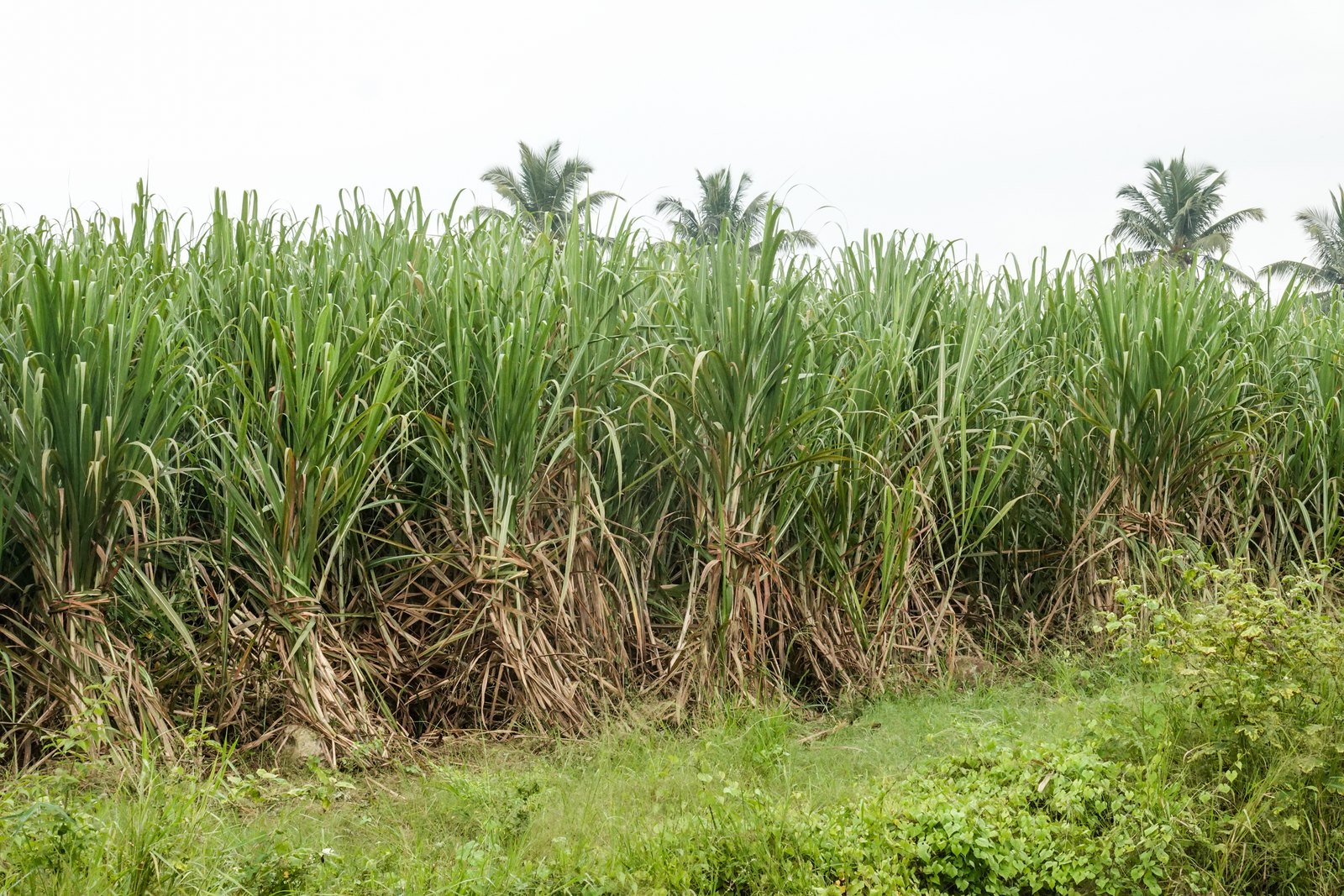
Photograph: This Photo was taken by Timothy A. Gonsalves. Feel free to use my photos, but, CC BY-SA 4.0. Source: Wikimedia Commons

On this page
Introduction
Sugar cane, Saccharum officinarum, is a tall perennial grass that stores sugar in its stems. A mature stalk stands 4 to 12 feet tall, is 0.75 to 2 inches thick, and is divided into nodes 4 to 10 inches apart, each node carrying a bud that can grow a new plant. That bud is the whole secret of growing it, because cane is grown from pieces of stalk and not from seed, and a single stalk can become dozens of plants.
This guide covers the noble cane, the species that was grown for thousands of years before modern hybrids replaced it, and it also says where a hybrid does better. We cover the choice of variant, planting from seed cane, the ratoon crops that regrow from the stubble, harvest, and the other parts of the plant you might grow it for. The stalk and its juice are the part we grow for, and we give no directions for eating the leaves.
Summary
- Warmth: 70 to 95 degrees F is the growing range. A hard freeze below about 22 degrees F kills the top growth of commercial canes.
- Sun and soil: full sun, well-drained soil with a pH of 5.5 to 6.5, and steady moisture.
- Planting: pieces of stalk 2 to 3 feet long with about six buds, laid in a furrow 3 to 7 inches deep and covered with 2 to 5 inches of loose soil, rows 6 feet apart.
- Time: about 12 to 14 months from planting to harvest, then 11 to 12 months for each ratoon crop.
- Harvest: cut as close to the ground as you can, trim the green top, and cut after the weather cools, when the sugar is highest.
- Care: the leaf edges cut skin, the juice is mostly sugar, and we do not burn fields or leaf trash.
The sections below follow the order of the work, from the plant and the climate to the choice of cane, the planting, the care, the ratoon, the harvest and the problems that come up.
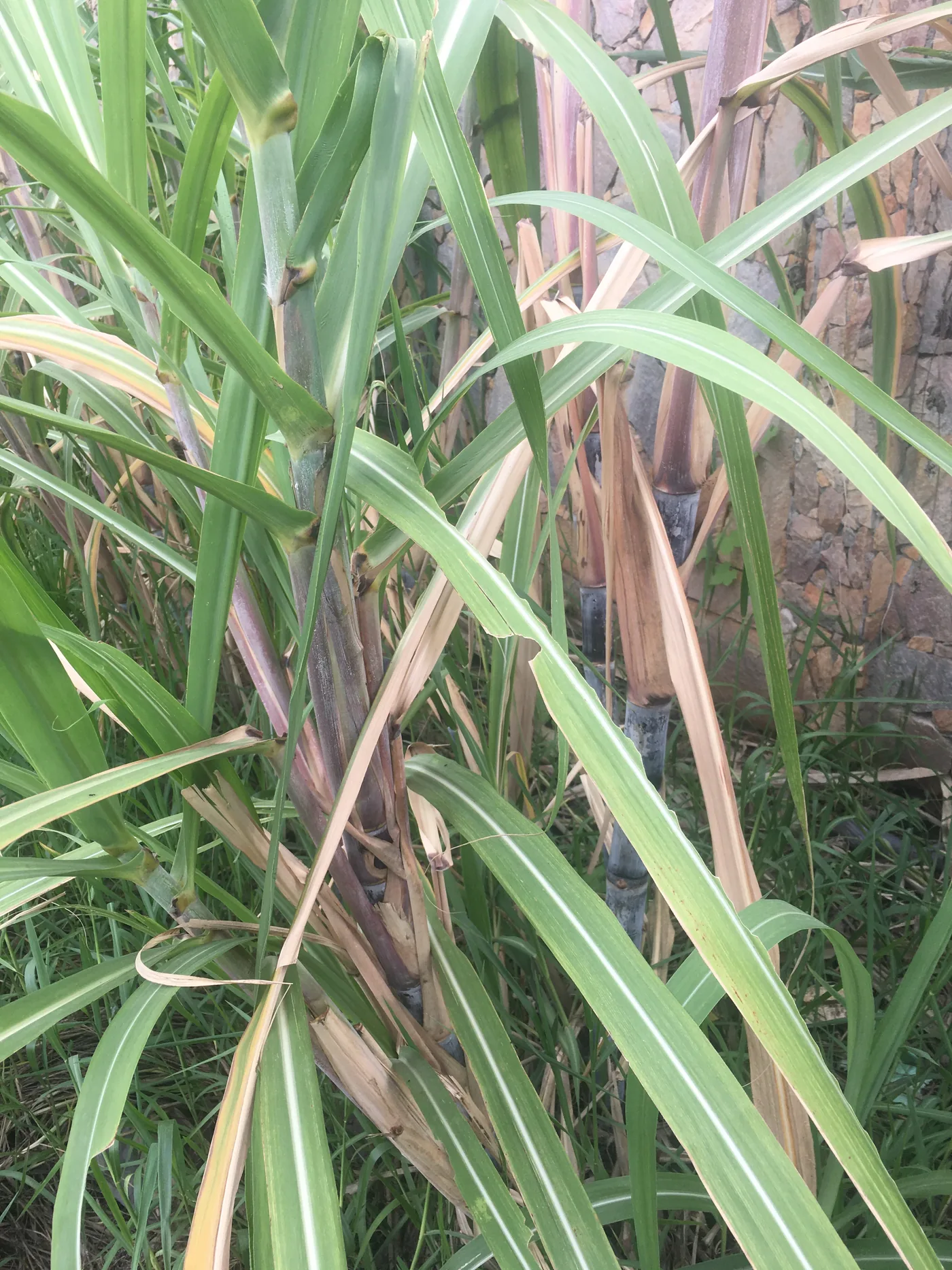

A clump like this grows from a single planted piece and fills out over one season, so one stalk bought in spring can supply seed cane for a whole row the next year.
Plant Description and Types
Sugar cane is a grass, like corn or bamboo, and its stems are jointed in the same way. It makes a thick clump of upright stalks from the base, and each stalk carries long arching leaves. A leaf blade runs 5 feet or more and 1 to 3 inches wide, and the edges are sharp enough to cut skin. Roots are fibrous and shallow, and the plant is perennial, so a planting regrows from the stubble after each harvest.
The noble canes, Saccharum officinarum, are the original sweet canes. They are thick and soft with a high proportion of juice and little fiber, and that is why they were grown for chewing and for syrup. They came from the region of New Guinea and spread with human travel. Nearly all modern commercial cane is a hybrid between noble cane and wild relatives, Saccharum spontaneum and Saccharum barberi, bred for tonnage and for tolerance of cold and disease. During that breeding the chewing quality and the attractive stripes and colors of the noble canes were largely lost.
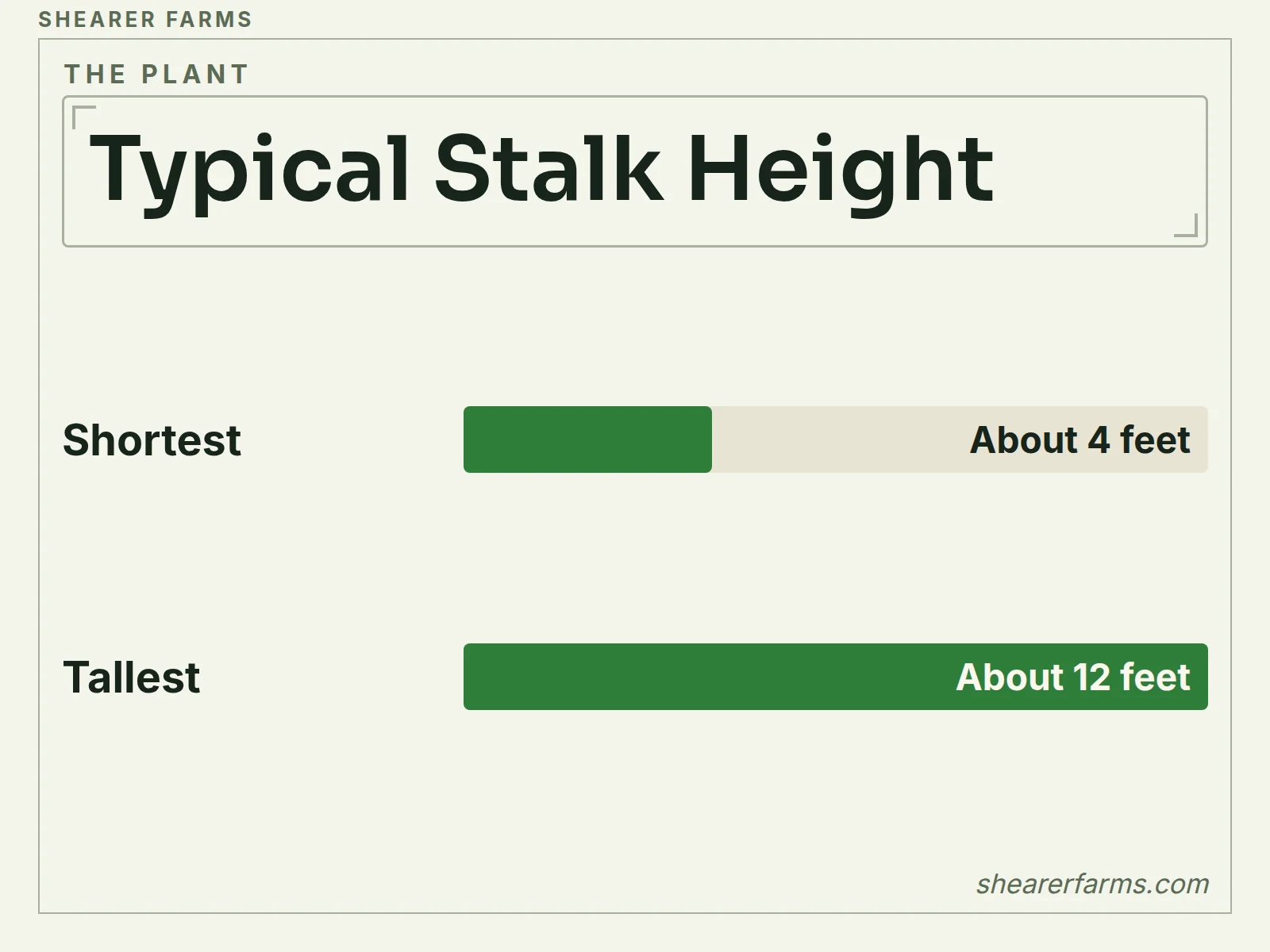
Height depends on the variety and the season. A cane planted late or grown in cool weather finishes shorter than one that has a long warm summer, and in this country the length of the warm season is the main limit on stalk size.
The plant has two sides to its character. It is a heavy feeder and drinker in its fast season, and it is a tropical plant that stops when the weather cools and dies back when a hard freeze arrives. Everything in the sections below is a way of giving it enough warmth, light, water and time.
Absinthe Wormwood Cultivation Guide
Complete guide to absinthe wormwood cultivation covering Artemisia absinthium, growing parameters, propagation, harvest timing.
For a More In-Depth Read, Click HereClimate, Heat and Freeze
Cane grows in the range of 70 to 95 degrees F (21 to 35 degrees C), and it grows fastest when days are hot and nights stay warm. Shoots from a planted piece appear in 1 to 3 weeks, depending on the soil temperature, and a cold soil slows them and can rot a piece before it sprouts. Plant only after the soil has warmed.
Freeze is the main risk where winters get cold. Louisiana's sugar program has described what temperature does to commercial cane in bands, and those bands are the best guide we found for a grower with a cold winter.
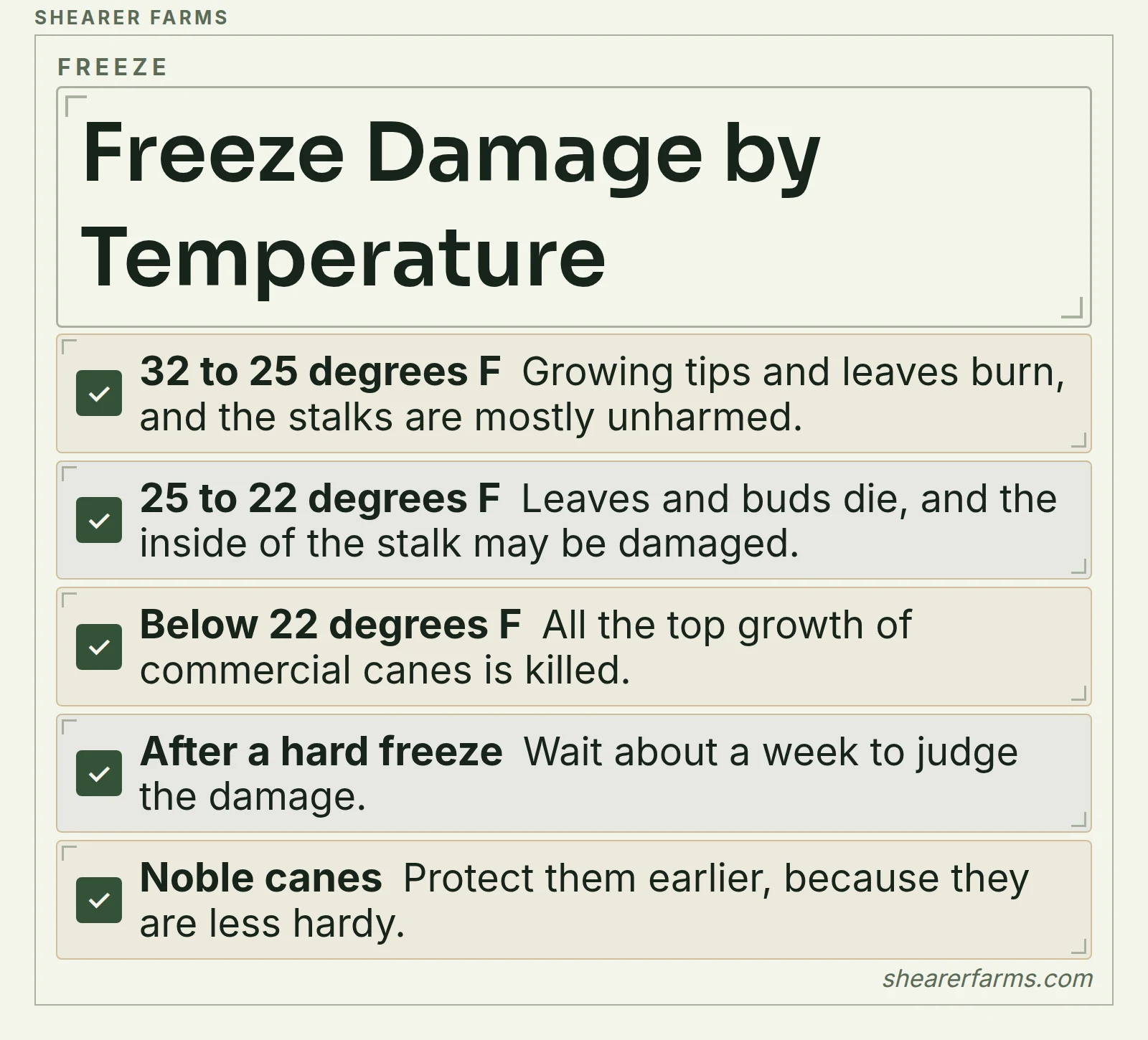
Those figures are for modern commercial varieties, and the noble canes are less cold tolerant, though we found no published freeze limit for a noble cane. Treat the bands above as the best case and protect noble cane earlier.
After a hard freeze, stalks can split and let in bacteria that lower the sugar, so a frozen stand should be harvested and processed soon after the damage is assessed. Louisiana growers wait at least a week to see what the freeze did before deciding. Where winters bring several hard freezes, the practical choices are to grow a hardier hybrid, to mulch the base deeply to protect the buds, or to cut the whole crop before the first hard freeze and keep some stalks cool and moist as seed cane for spring.
This is how we handle our own cane. Thai purple and heirloom cane both die back in the winter, so we harvest and take cuttings before a freeze. The root ball will usually survive the winter, so the clump is not lost even where the top growth is.
Sun, Soil and Water
Cane wants full sun, and a planting that gets less than 8 hours of direct light grows thin stalks with little sugar. Choose a site open to the sun and away from the shade of buildings and trees, and keep it away from walkways, because the leaf edges cut anyone who brushes past.
The soil should be well drained, deep and loose, with a pH of about 5.5 to 6.5. A loam or clay loam with plenty of organic matter holds moisture without staying wet, and sandy soil needs more water and more feeding. Check the pH with a soil test before you plant, and add lime if it is well below 5.5. A soil test also tells you what the plot lacks, which is better than guessing at a fertilizer.
Water matters in two ways. Cane needs steady moisture through its fast summer growth, and the soil should be slightly moist and never dry for long. It also needs air at the roots, so a piece planted in soggy ground rots before it sprouts. Once the shoots are 6 to 8 inches tall they tolerate short periods of standing water, but a long flood still harms them.
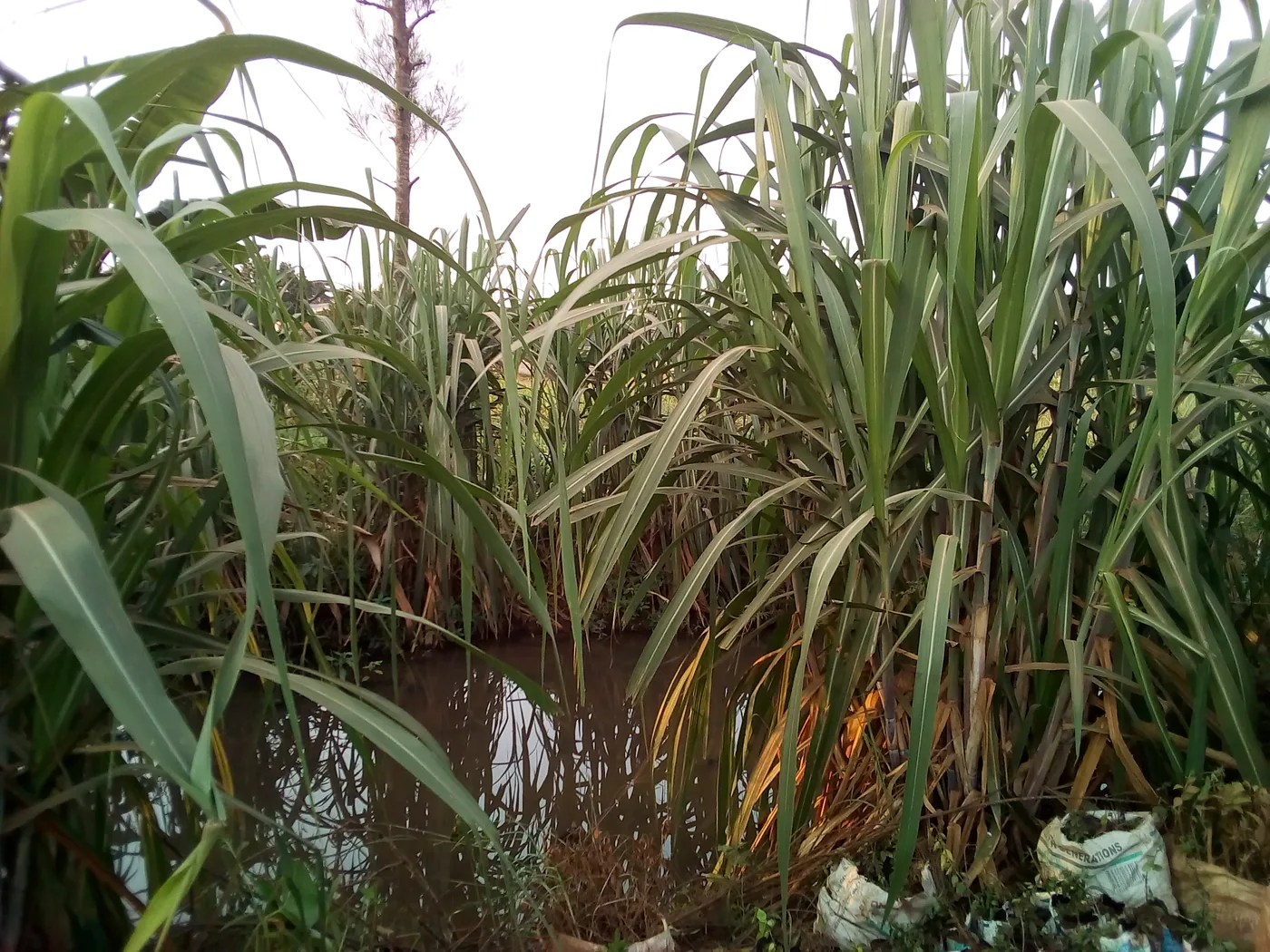

Cane in standing water is a sign that the site needs drainage, and a raised bed or a ridge for each row is the simplest fix on a flat, heavy plot.
Mulch the soil between the rows with the leaf trash from last year's cane. It holds moisture, suppresses weeds and returns nutrients, and it is better for the soil than burning the trash.
Variants Worth Growing
A grower asks three questions before buying cane: which variety gives the most stalk, which has the most of the compound you want from it, and which survives the coldest winter. Each answer is below with the reason, and each says how far the evidence goes. For noble cane, the honest answer is that the published trials are thin.
We grow two canes ourselves, Thai purple and heirloom sugar cane, and both are useful to us. Thai purple has dark purple stalks. In purple-rind noble cane the color comes from anthocyanins, and a 2021 study of the purple-rind noble cane Badila named cyanidin-based pigments as the main ones in the rind. A Thai study has also measured phenolics and anthocyanins in a dark purple-to-black cane sold in Thailand. We found no published analysis of Thai purple cane under that name, so how its pigment content compares with our heirloom cane is not measured, and the rows below do not rank it.
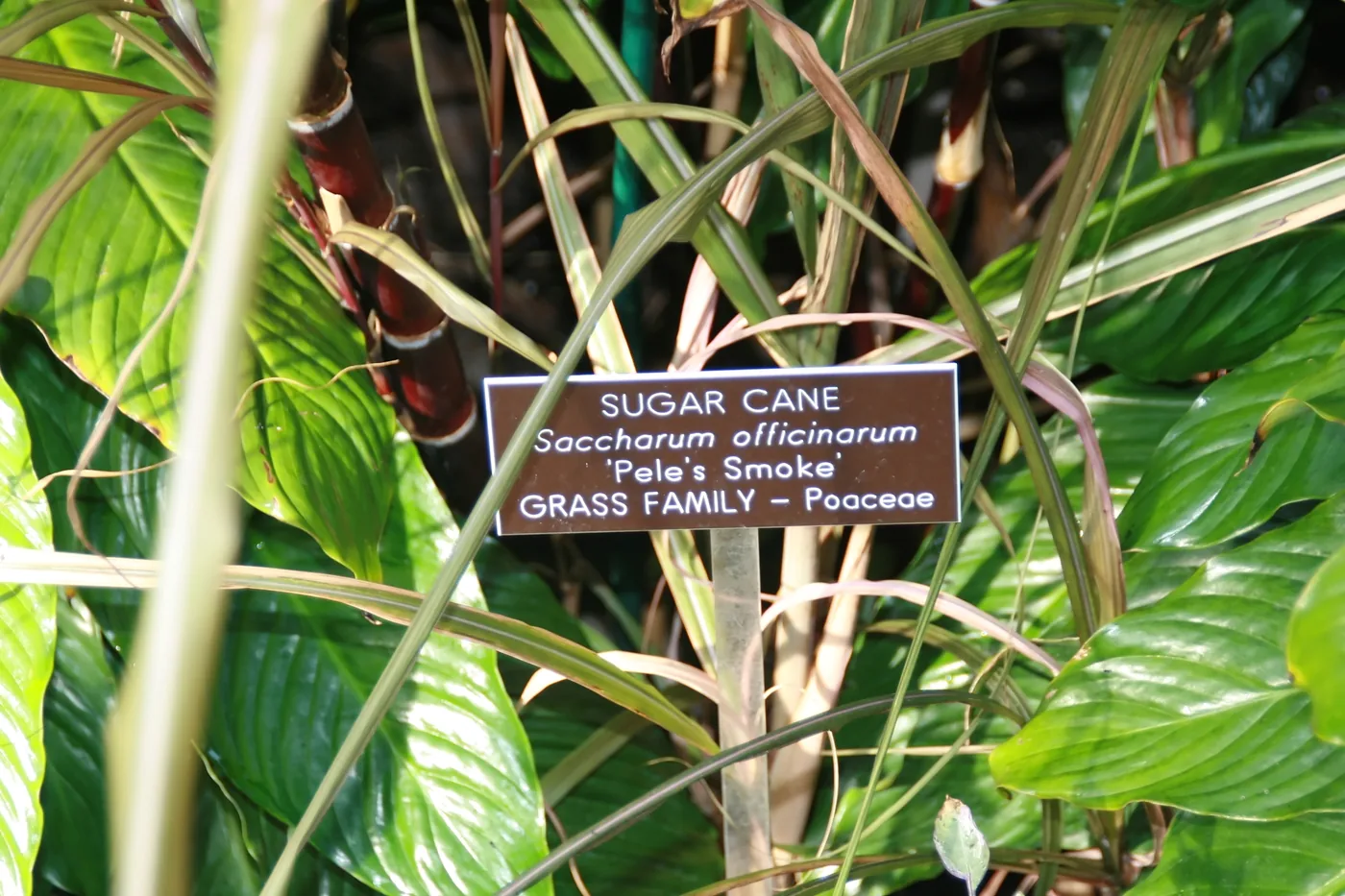

Read each row for its reason as well as its name, because the reason tells you whether it holds on your own plot.
| Question | Variant | Why |
|---|---|---|
| Top Yielding | A modern commercial hybrid such as the Louisiana CP varieties (CP 67-500 is a listed syrup cane), for weight of cane per acre | Hybrids were bred for tonnage, and commercial irrigated cane in the Rio Grande Valley averaged about 31 to 42 tons per acre over 2012 to 2018. For a noble cane, Badila is described as having much thicker stalks than most, but we found no side-by-side yield trial of noble canes. |
| Highest In sucrose | Noble canes as a group, and named chewing canes such as Yellow Gal and White Transparent | Noble canes were kept for their high juice quality, low fiber and soft stalks, and extension lists name Yellow Gal and White Transparent as chewing canes. No source gives a Brix for these varieties side by side, so measure your own with a refractometer. |
| Highest In flavones | Dark-rind noble canes such as Ko honua ula, the black cane, and Pele's Smoke, are the likeliest to differ, but this is not measured | Cane flavones are mainly apigenin, luteolin and tricin derivatives found in the leaves, rind and juice. We found no published comparison of varieties, so the best way to know is to test your own batches against each other. |
| Hardiest | A modern Louisiana-bred hybrid, or the old Louisiana syrup canes Louisiana Ribbon, Louisiana Purple and Green German | Louisiana's cane specialists say varieties bred in the last 30 years are more cold tolerant, and the old syrup canes have a record in a climate that freezes. Noble cane is the tender end of the species, and no source gives a measured freeze limit for these. |
If you grow only one, grow the type that matches your goal. A cane for chewing and juice is a noble cane, and a cane that must survive a cold winter is a hybrid. The old Louisiana canes are listed as exceedingly difficult to find, so ask a nursery or a seed cane exchange early.
Growing For Juice, Seed Cane and Other Parts
What you grow cane for decides almost everything about how you grow it. This guide treats two goals as the main ones: the sap, which is the sugary juice in the stalk, and the clones, which are the pieces of stalk that become new plants. Everything that raises the yield of one also helps the other, and the differences are in the timing.
We grow Thai purple and heirloom cane for their sugar. We use that sugar in Korean natural farming ferments and in molasses-type additions to our nutrients, which feed the microbes in the soil. Korean natural farming makes fermented plant juice by mixing cut plant material with an equal weight of brown sugar and letting it ferment for about a week (University of Hawaii CTAHR), so sugar we make ourselves from the juice is a direct input to that method. The simple ways to turn the juice into sugar, syrup, jaggery and molasses are in the companion extraction guide.
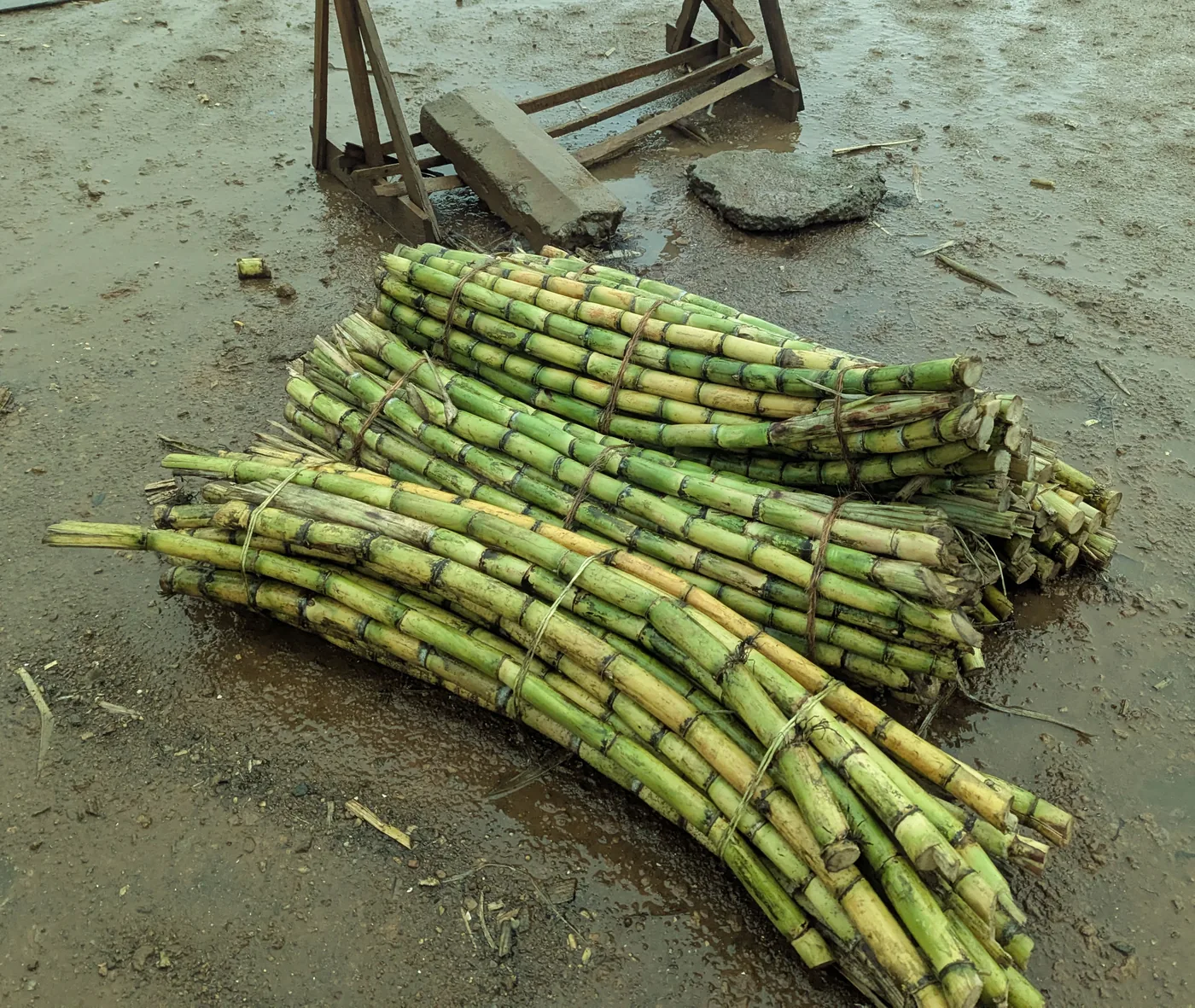

For juice, the aim is heavy, thick, sweet stalks. Give the plant full sun, a steady supply of water through the fast summer growth, and enough nitrogen and other nutrients that it never stalls, with a soil test setting the amounts. Space the rows 6 feet apart so each clump gets light and air, and keep weeds out until the cane shades the ground. Sugar builds in the last months, so leave the cane standing until the weather has cooled, because sugar yields generally rise as it does. Cut it low, because the root end of the stalk is the richest in sugar, and trim the green top that has no sugar-storing nodes.
For seed cane, the aim is many healthy, fully budded stalks. Grow the planting for the same 12 to 14 months, and choose the best stalks, those that are thick, straight, free of damage and carrying sound buds. Cut each stalk into pieces with about six buds, and store them cool and moist for up to two weeks if you cannot plant them at once. A stalk that is cut for seed cane is not the one you press for juice, so mark a few rows for seed from the start and do not press them.
If you want something else instead, the plan changes. If you want leaves for mulch or for a flavone extract, let the plant leaf out fully and strip the older leaves during the season, wearing gloves. For seed from flowers, you need a tropical climate and a day length near 12.5 hours with warm nights of 68 to 77 degrees F, because cool nights and water stress stop flowering, and seedlings from true seed differ from their parent. For the rind wax, harvest dry mature stalks and keep the rind, and do not wash it hard. Each of these parts is a different harvest, so decide before you plant which part matters most.
Getting Seed Cane
Seed cane is the stalk you plant, and its quality sets the quality of the whole planting. Buy it from a nursery or a grower you trust and ask for fresh, healthy stalks from a non-flowering plant, free of rot, dry rind and insect holes. A stalk with a red, discolored or sour-smelling cut face may be carrying a disease and is best refused.
You will most often receive whole stalks or long pieces. Cut them into planting pieces, called setts, about 2 to 3 feet long, with about six buds each. Use a sharp knife or a machete on a stable block, make clean cuts and wear gloves. Some growers cut shorter pieces with two or three buds, and they sprout, but the longer pieces are more forgiving of a cold or dry spell.
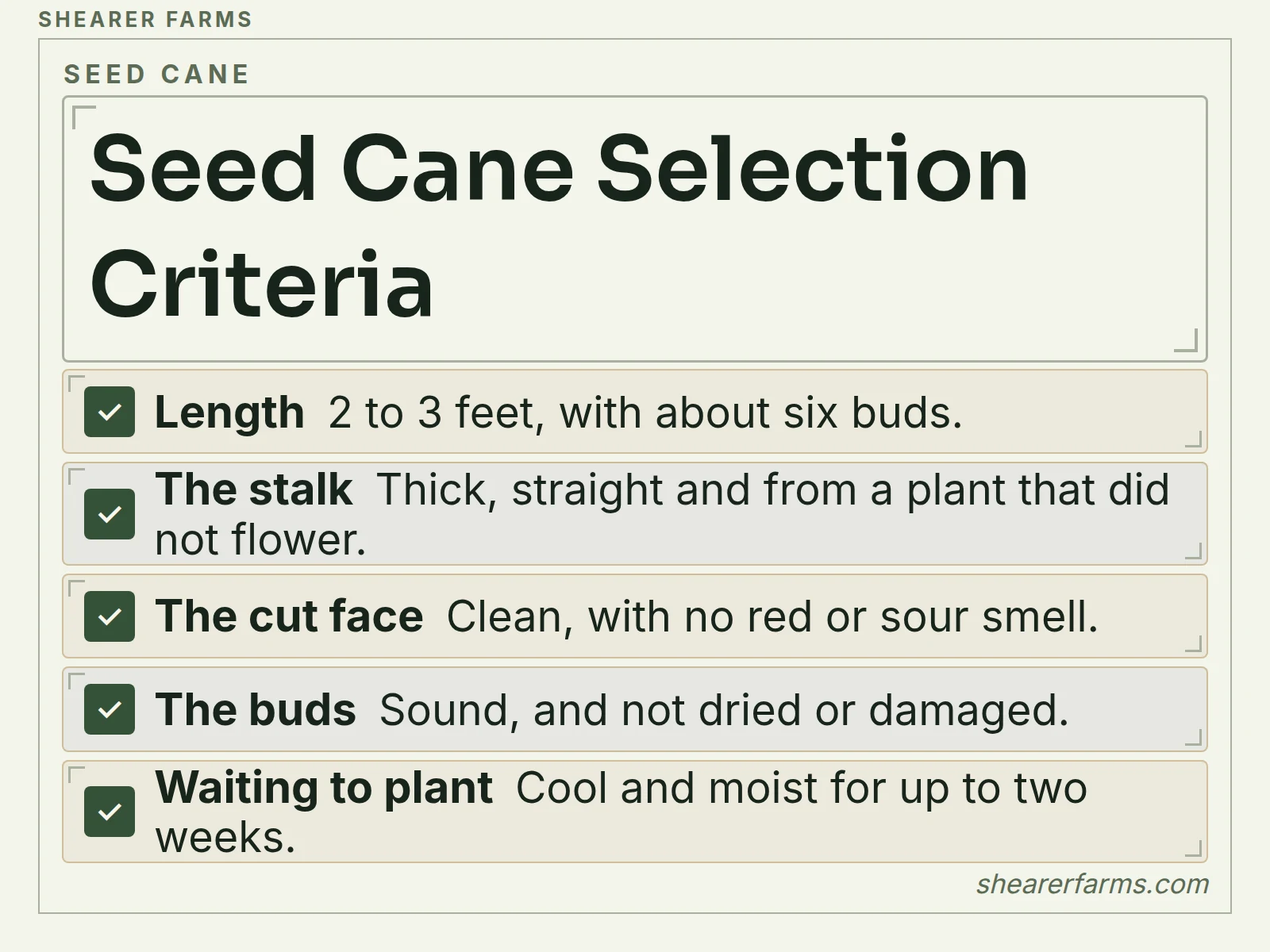
If you cannot plant at once, keep the stalks uncut, in the shade, in cool moist conditions, and cut them just before planting. Stored cuttings keep in cool, moist conditions for up to two weeks, and longer storage calls for hot paraffin on the cut ends to seal them against drying and rot.
Seed cane from your own plantings is free, but it carries the disease of the parent plant, so replace your seed cane from a clean source now and then. Replant the whole planting every 5 to 10 years even when the ratoons keep coming, because old stools lose vigor.
Planting Step by Step
Plant when the soil has warmed and the last hard frost has passed, so the buds sprout quickly and the young shoots do not meet a freeze. The work is simple, and it goes best when the furrows are ready before the cane arrives.
- Loosen the soil to a spade's depth and work in compost, then open furrows 3 to 7 inches deep, a little deeper in sand or in very organic soil.
- Space the furrows 6 feet apart so the full-grown clumps have room and light.
- Lay the setts end to end in the furrow, overlapping the ends a little, with the buds to the sides and not facing up or down.
- Cover them with 2 to 5 inches of loosely packed soil, leaving the soil loose so the shoots can come through.
- Water gently and keep the soil slightly moist and not wet until the shoots appear in 1 to 3 weeks.
- Mark the end of each row with the variety and the date, and keep a note of it.
The 6 foot row spacing above is the general figure. Thai purple and heirloom cane can be grown close together, because each grows in a clump and sends up long stalks.
Cover depth is a balance: too shallow and the sett dries out, too deep and the buds struggle to reach the surface. The planting figures in one standard reference for home growers fit a loam or clay loam.
Once the shoots reach 6 to 8 inches, thin any that are crowded, fill the soil gradually around them and begin the routine of water, mulch and weeding.
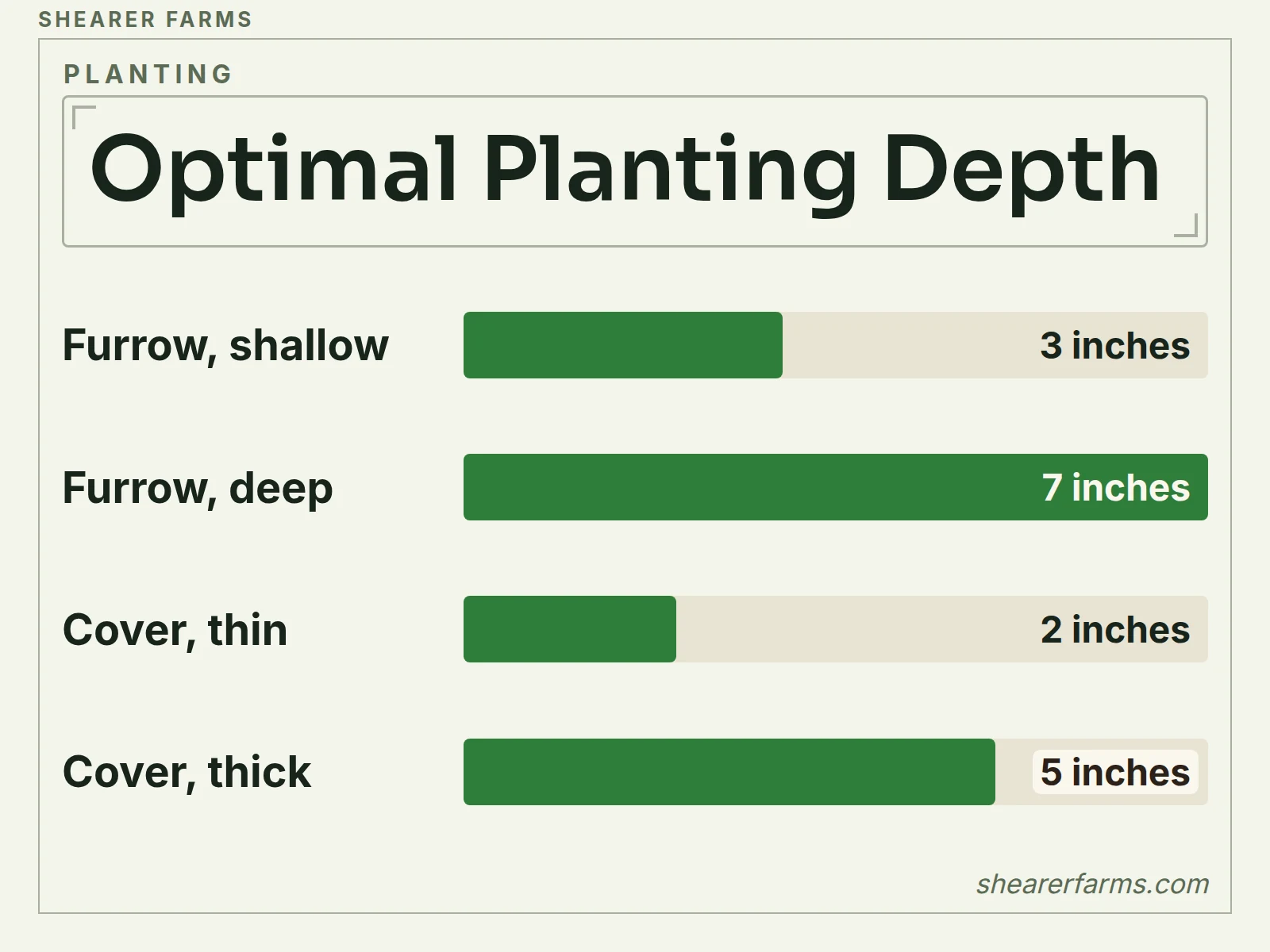
Those depths are a working range, and the exact value depends on your soil, so keep notes on how quickly your setts sprout at each depth and use your own results the next year.
Water, Feeding and Weeds
After the shoots are up, the work is to keep the plant growing fast through the warm months. Give cane a deep watering rather than frequent sprinkles, so the roots reach down, and water more in the hot weeks of summer when growth is at its peak. Stop heavy watering as harvest nears and the weather cools, because the plant is now filling the stalk with sugar and a wet root zone dilutes it.
Feeding follows the soil test. Cane is a heavy feeder, and the nutrient that most often limits growth is nitrogen, so a plot without enough of it produces thin pale stalks. Apply compost at planting and again in early summer, and add a nitrogen source in the amount the test and the stalk color suggest. Too much nitrogen late in the season delays ripening and lowers sugar, so finish feeding by late summer.
Weeds are the other competitor. Young cane is slow at first and weeds crowd it out easily, so weed by hand or hoe through the first two months and then mulch heavily with leaf trash. After the canopy closes the cane shades out most weeds on its own.
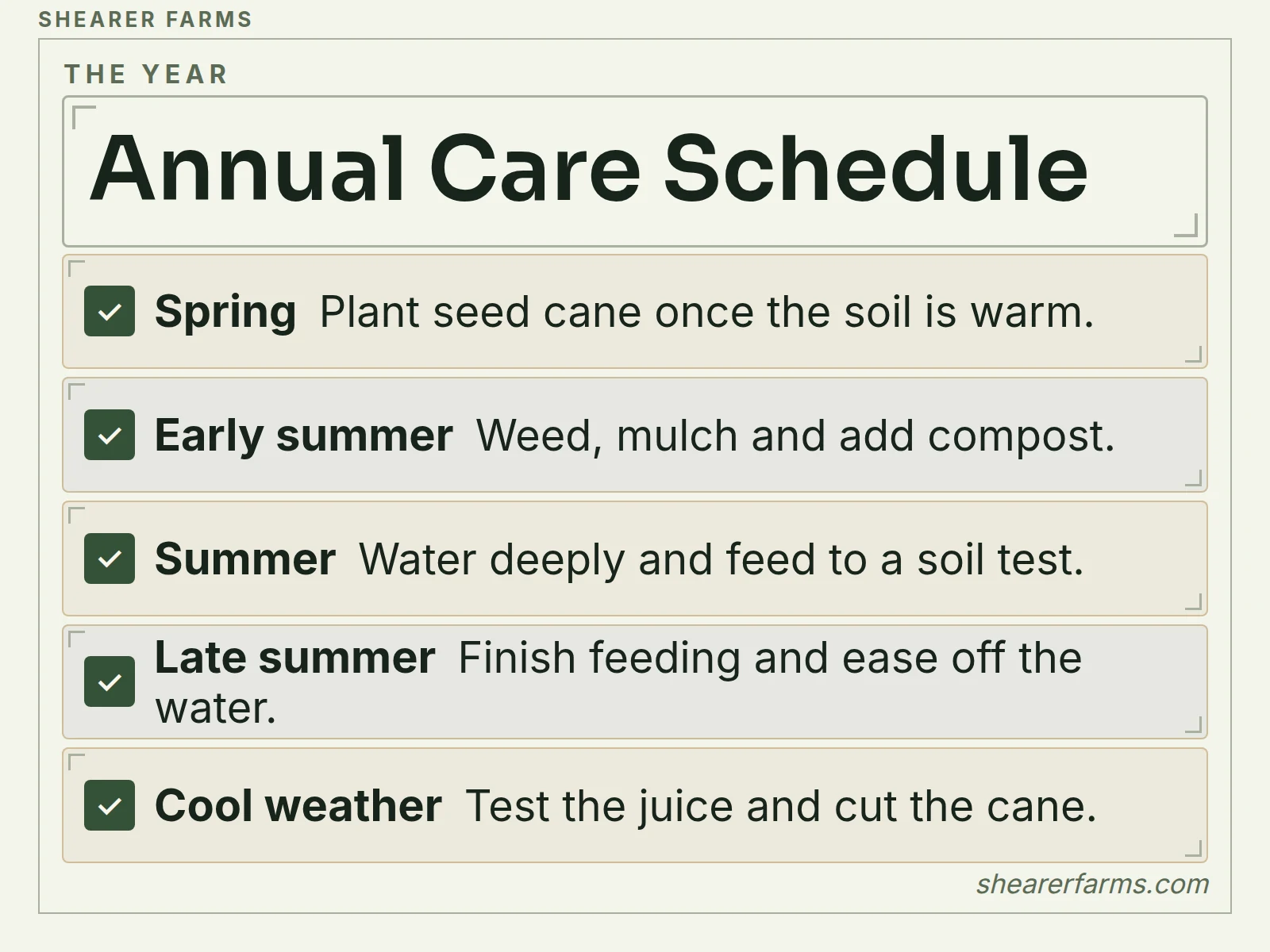
The year in the cane field is short to write down and long to carry out, and keeping a calendar for your own plot is the best way to see how each practice changed the result.
Complete damiana cultivation guide covering Turnera diffusa botany, semi-tropical growing, apigenin and arbutin chemistry.
For a More In-Depth Read, Click HereLeaf Trash, Mulch and Why We Do Not Burn
A cane plot makes a lot of leaf trash, the dry leaves that peel from the stalks and the green tops cut at harvest. Commercial growers have burned fields before harvest for generations to remove it, and you will see photographs of that practice. We do not advise it for a small plot, and the reasons are practical.
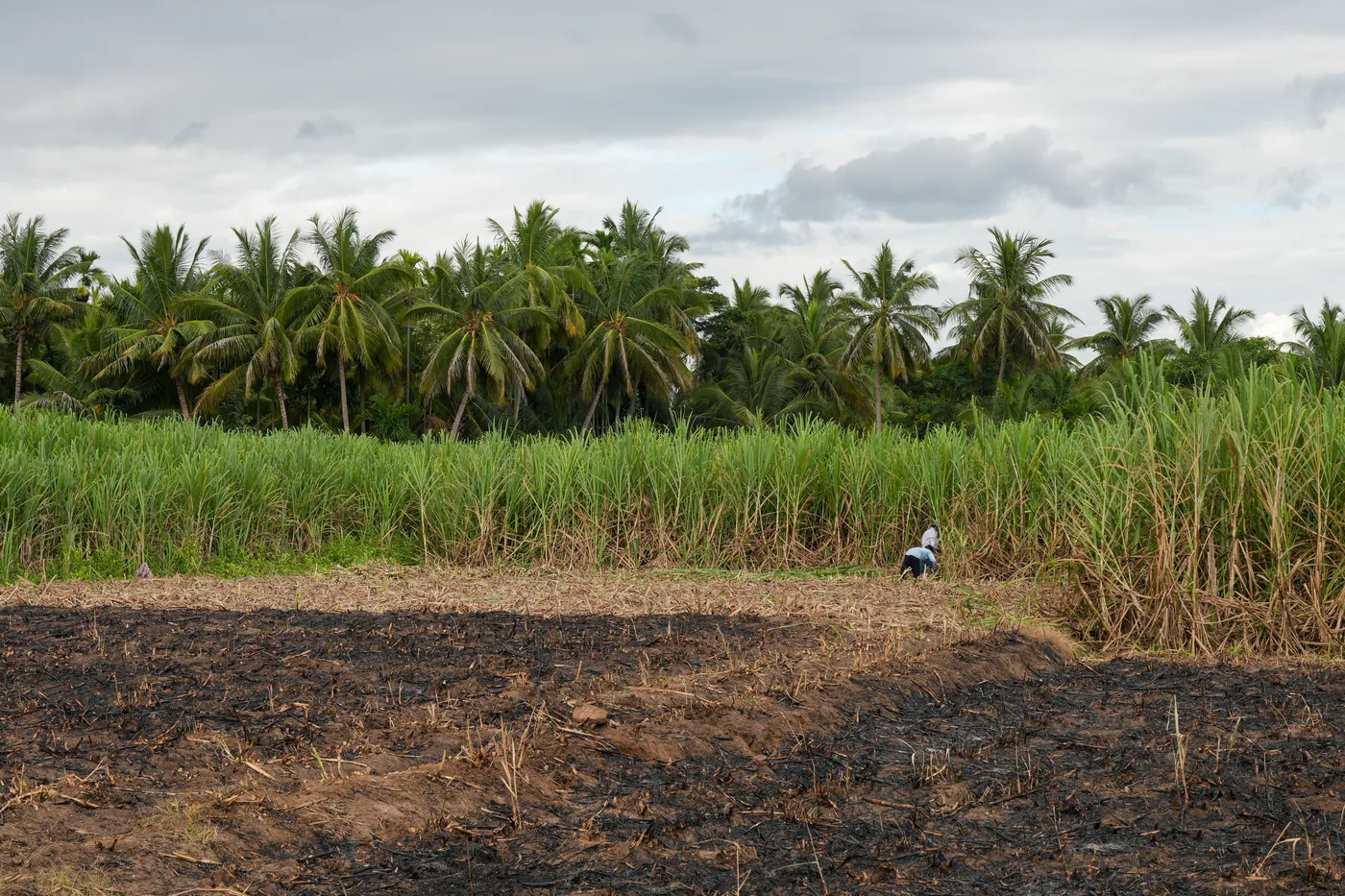

Burning sends smoke across your neighbors' land, it can run out of control in dry weather, and it destroys the mulch the soil would have received. Cane leaves are razor sharp and difficult to handle, but they are also a rich mulch, and left on the ground they hold moisture, suppress weeds, protect the buds of the ratoon in a freeze and break down into organic matter.
Strip the dry leaves by hand with gloves as the season goes on, and lay them between the rows. At harvest, cut the tops and drop them in the row as well. Keep the mulch a few inches away from the base of the new shoots in spring so the soil can warm, and pull it back into place once the shoots have grown.
Leaf trash also makes good compost for other beds, and the bagasse and ash from processing return minerals to the soil, so a grower who uses all of it buys less fertilizer than one who burns it.
Ratoon Crops
A ratoon is a crop that regrows from the stubble after the cane has been cut. Because the roots and the buds are still in the ground, new shoots come up within days of harvest, and the planting yields again without any seed cane or planting labor. The first crop after planting is called plant cane, and each regrowth after it is a first ratoon, a second ratoon and so on.
Timing is shorter for a ratoon. Plant cane takes about 12 to 14 months from planting to harvest, and a ratoon takes about 11 to 12 months from regrowth. In a region with a long warm season, a grower can therefore take a crop each year from one planting.
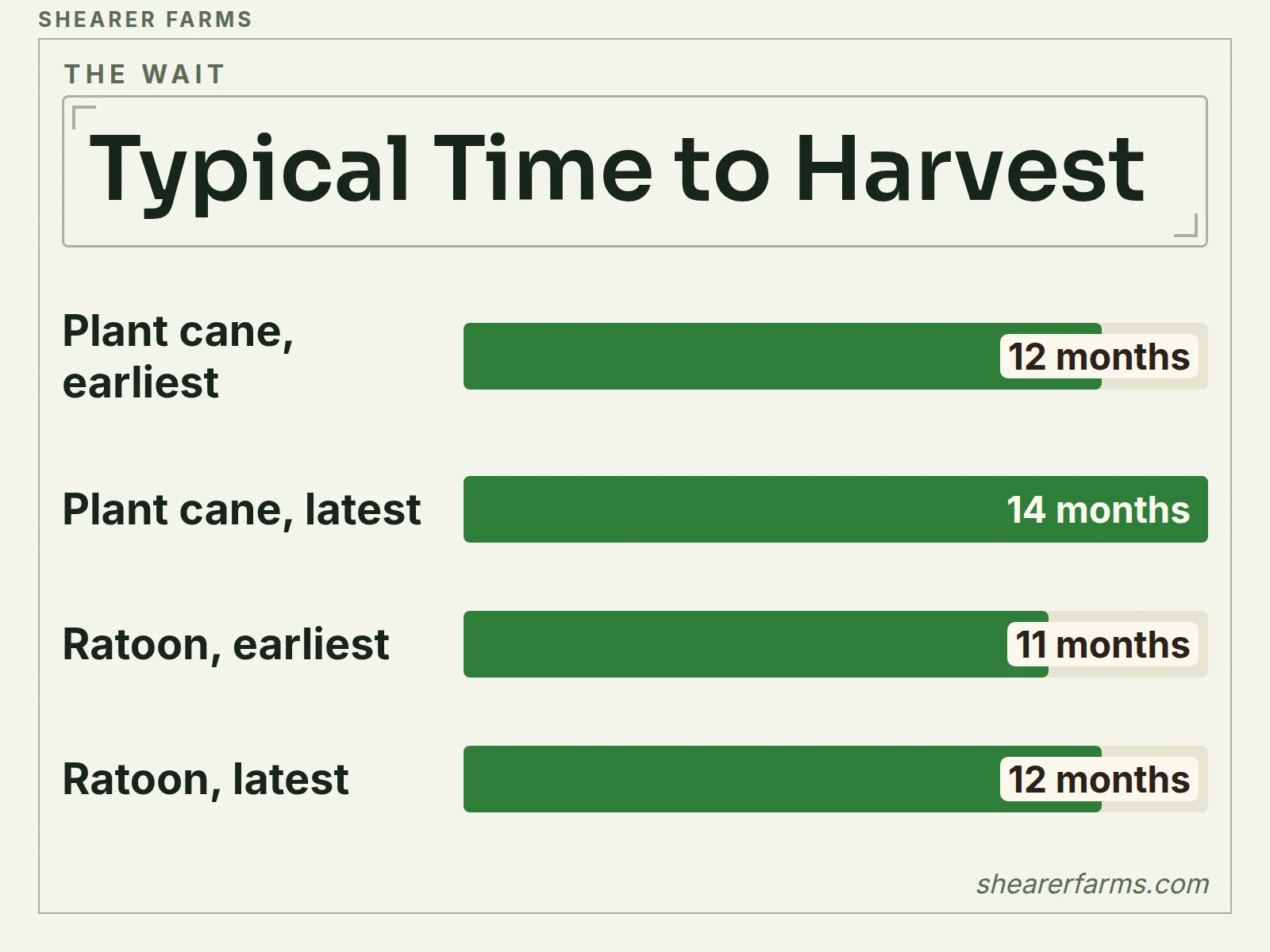
To get a good ratoon, cut the stalks as low as you can at harvest so the new shoots come from buds below the soil surface, where they have their own roots. Leave the leaf trash on the ground as mulch, water the stubble well, and feed it with nitrogen as the shoots come up, because a ratoon starts without a fresh supply of compost.
Yields of the later ratoons generally fall below the plant cane crop, and breeders measure how well a variety holds its yield through the ratoons. In Texas trials, each planting was followed through plant cane and several ratoon crops for exactly that reason. For a home grower, a good rule is to keep a ratoon as long as the stalks stay thick, and replant when the stools thin, usually after a few crops, and in any case within 5 to 10 years.
A freeze that kills the top growth does not always kill the stool. If the buds near the ground are alive, a ratoon can regrow in spring, which is one more reason to mulch the base heavily before winter.
Flowering and Seed
A mature cane plant can send up a tall plume, called an arrow, topped with a silky flower head. Flowering is triggered by day length near 12.5 hours and by night temperatures between 68 and 77 degrees F, and low temperatures and water stress prevent it. In many regions, including most of the temperate world, cane never flowers at all.
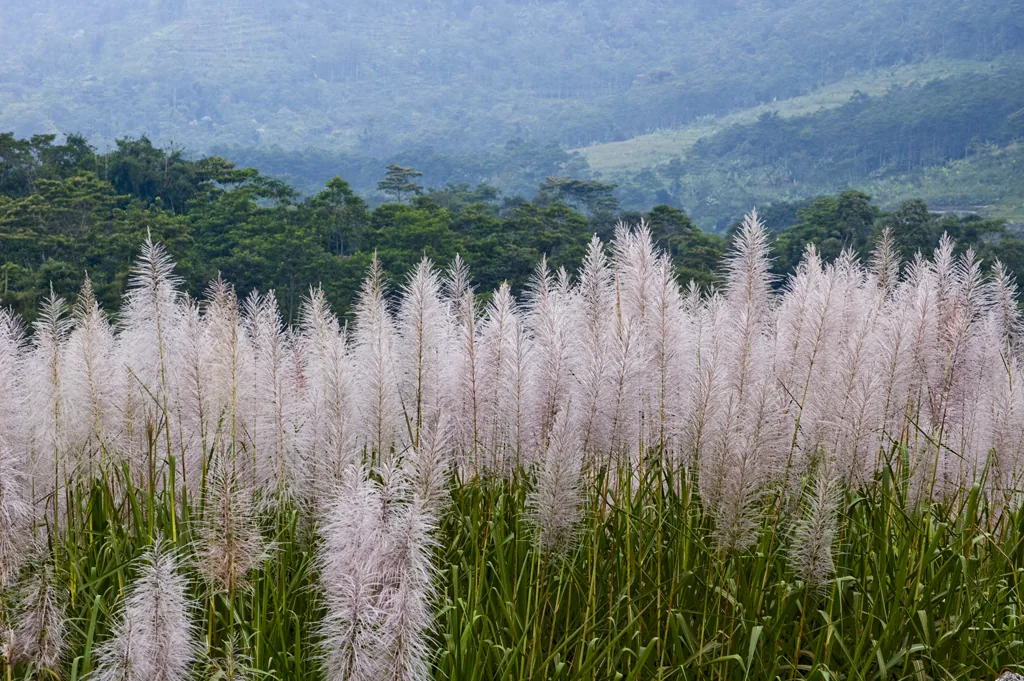

For the grower, flowering matters mostly because of what it makes. A flower makes true seed, the tiny fuzzy grains of the plume, which grow into seedlings that differ from the parent plant.
That second point is why cane is planted from stalk pieces and not from seed. A plant grown from a piece of stalk is a clone of the parent, with the same stalk color, sugar and habit. A plant from true seed is a new combination of its parents' traits, which is how breeders make new varieties, but it is a gamble for a grower who wants a known cane.
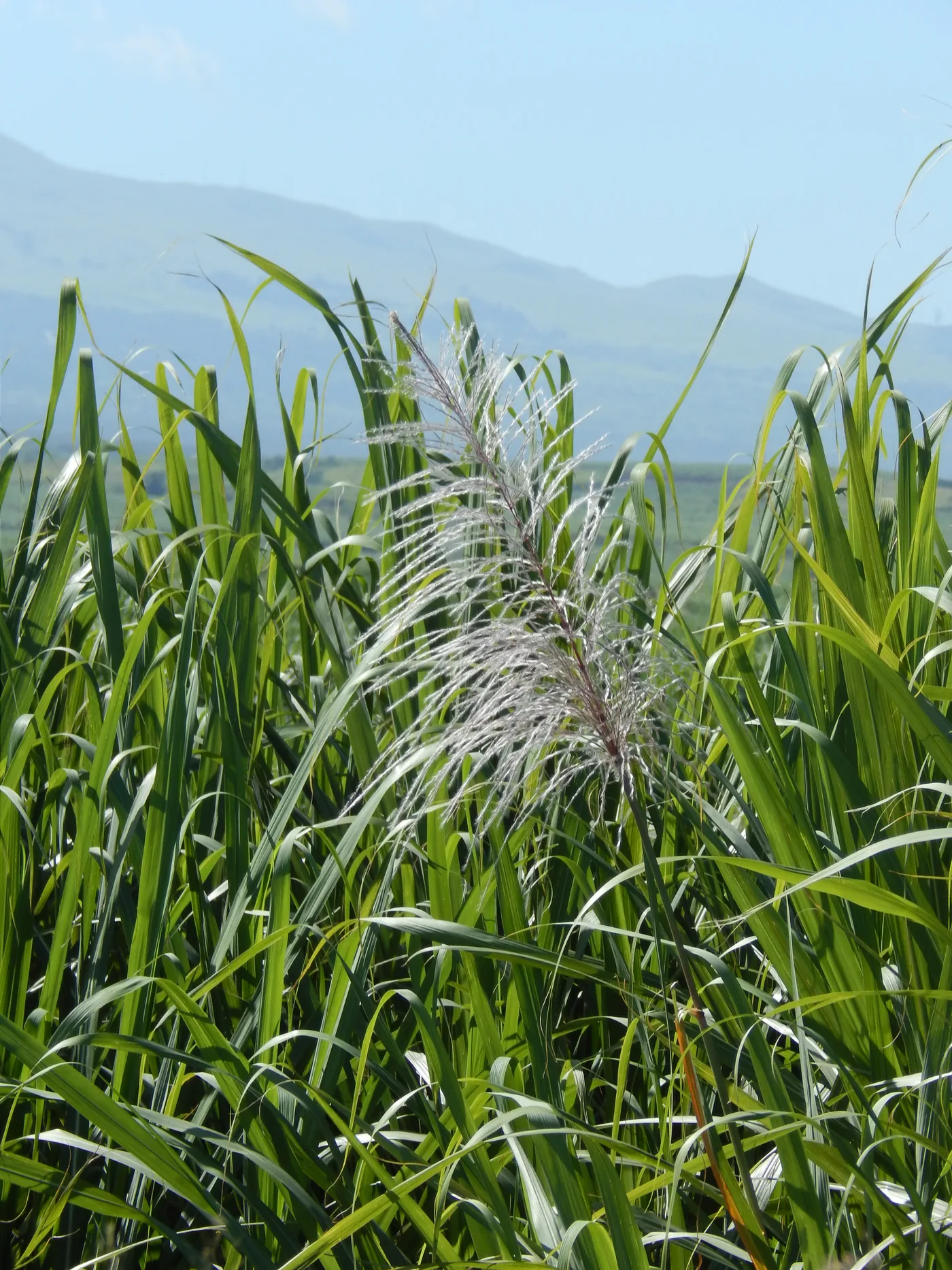

If you want to try growing from true seed, treat it as a breeding project. It needs a warm greenhouse for the flowers to form pollen and set seed, sowing on the surface of a fine mix, and patience to wait for the seedlings to show their quality over a few years before you choose the best.
The ordinary grower should leave the plumes alone, cut the cane for juice when the weather cools, and plant stalk pieces for the next crop.
Pests and Problems
Cane is a tough plant, and most problems in a small plot come from the conditions and not from an insect or a disease. Check the basics first, which are water, drainage, light, feeding and freeze damage, and look at the pests only when those are right.
The common problems are easy to recognize. Pale thin stalks mean low nitrogen or too little light. Yellow leaves in wet soil mean the roots lack air. Brown leaf tips and a stalled stand in a dry spell mean thirst. Stalks that lie over in a storm are lodged, which is more common on tall canes in soft, wet soil. Brown tops after a cold night are freeze burn, and the amount of damage below depends on how cold it got.
Insects that feed on cane include borers that tunnel into the stalk and sap-feeding insects on the leaves. A hole in a stalk with sawdust-like frass beside it points to a borer, and a bored stalk should be cut out and discarded so the pest does not spread. Rats and other animals gnaw sweet stalks near harvest, and a clean field edge with the trash cleared back from the rows lowers the cover for them.
Plant disease travels on seed cane. A piece with a red, sour-smelling or discolored cut face should not be planted, and a plant that grows poorly from clean seed cane in good conditions should not be used as a source of seed cane. Replacing seed cane from a clean source every few years is the best protection.
When a problem is not clear, take a photograph and a cut stalk to your local extension office, because they see the local pests and can name them.
Complete chamomile cultivation guide covering German chamomile botany, self-seeding strategies, apigenin and bisabolol chemistry.
For a More In-Depth Read, Click HereHarvest
Cane is ready 12 to 14 months after planting, or 11 to 12 months from regrowth for a ratoon. Sugar yields generally rise as the weather cools, so the best harvest is on a cool, dry day in autumn or winter, before the first hard freeze. Test by cutting one stalk and measuring the juice with a refractometer, which reads the sugar as Brix, and harvest the plot when the reading stops rising.
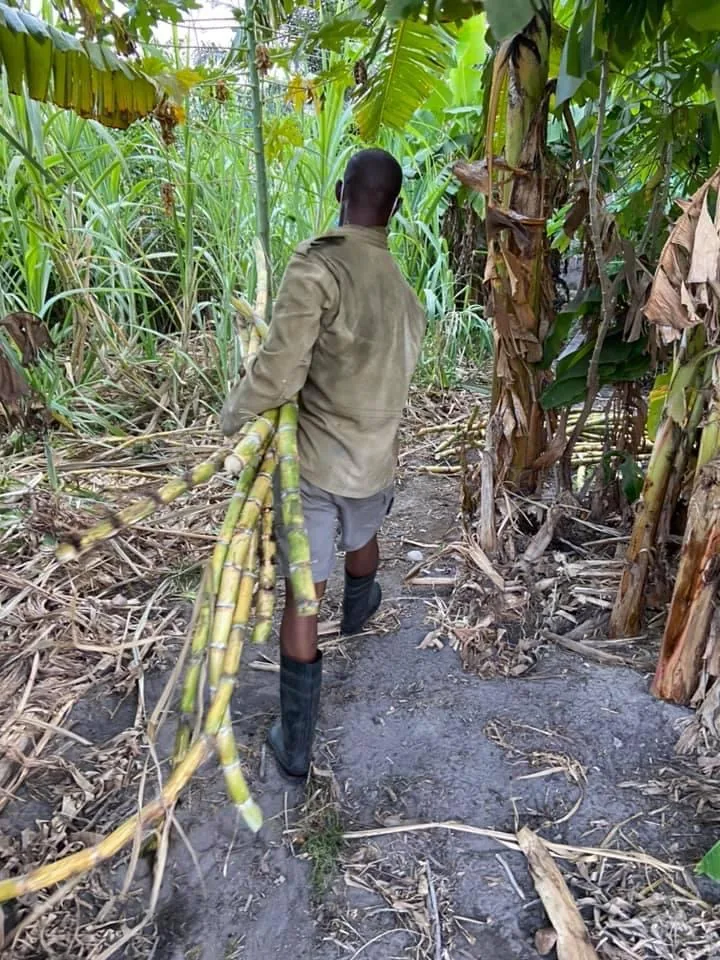

Cut each stalk as close to the ground as you can with a machete or a cane knife, because the root end is the richest in sugar and the cut low also leaves good buds for the ratoon. Trim the green upper part, which has no sugar-storing nodes, and strip the leaves. Work with gloves, sleeves and eye protection, and keep other people out of the swing of the blade.
Stack the cut stalks in bundles and carry them to the press or the shade at once. Cane begins to lose juice and sugar once it is cut, and warm weather speeds the loss, so a plot is best cut in batches you can press within a day or two.
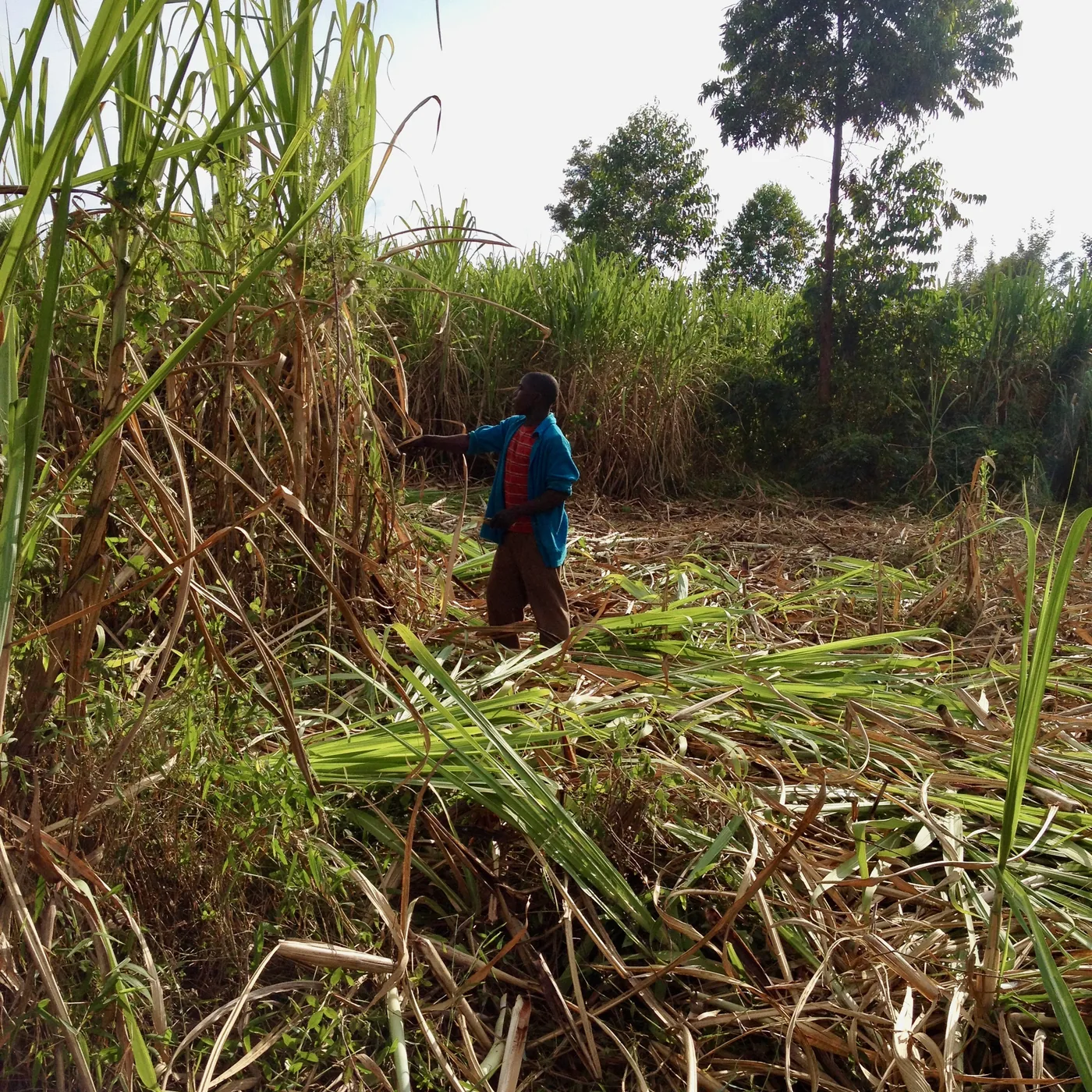

After a hard freeze, cut and press the damaged cane soon, because split stalks let bacteria in and the sugar falls quickly. In a mild winter, leave the plot standing and harvest it in portions through the cool months, which spreads the work and lets you sample the sugar over time.
Save the tops and the leaf trash as mulch, keep the best stalks for seed cane, and cut the stubble low so the ratoon starts well.
Keeping the Harvest
Whole stalks keep better than juice, and juice keeps for hours at room temperature, so the decision about what to store comes before the harvest. Cut and press in batches that you can finish within a day or two, and trim a thin slice off each cut end before you press, because the ends dry out first.
Raw juice is close to neutral in acidity, and one study measured a pH of 5.55 and a shelf life of a few hours for freshly pressed juice. It browns quickly and turns sour. Press only what you will use, chill it on ice, and keep it in the refrigerator for a day at most. A pasteurized and acidified juice at pH 4.35 held for 94 days at 4 degrees C in laboratory conditions, but that depends on clean bottling and heat treatment that a home kitchen cannot match.
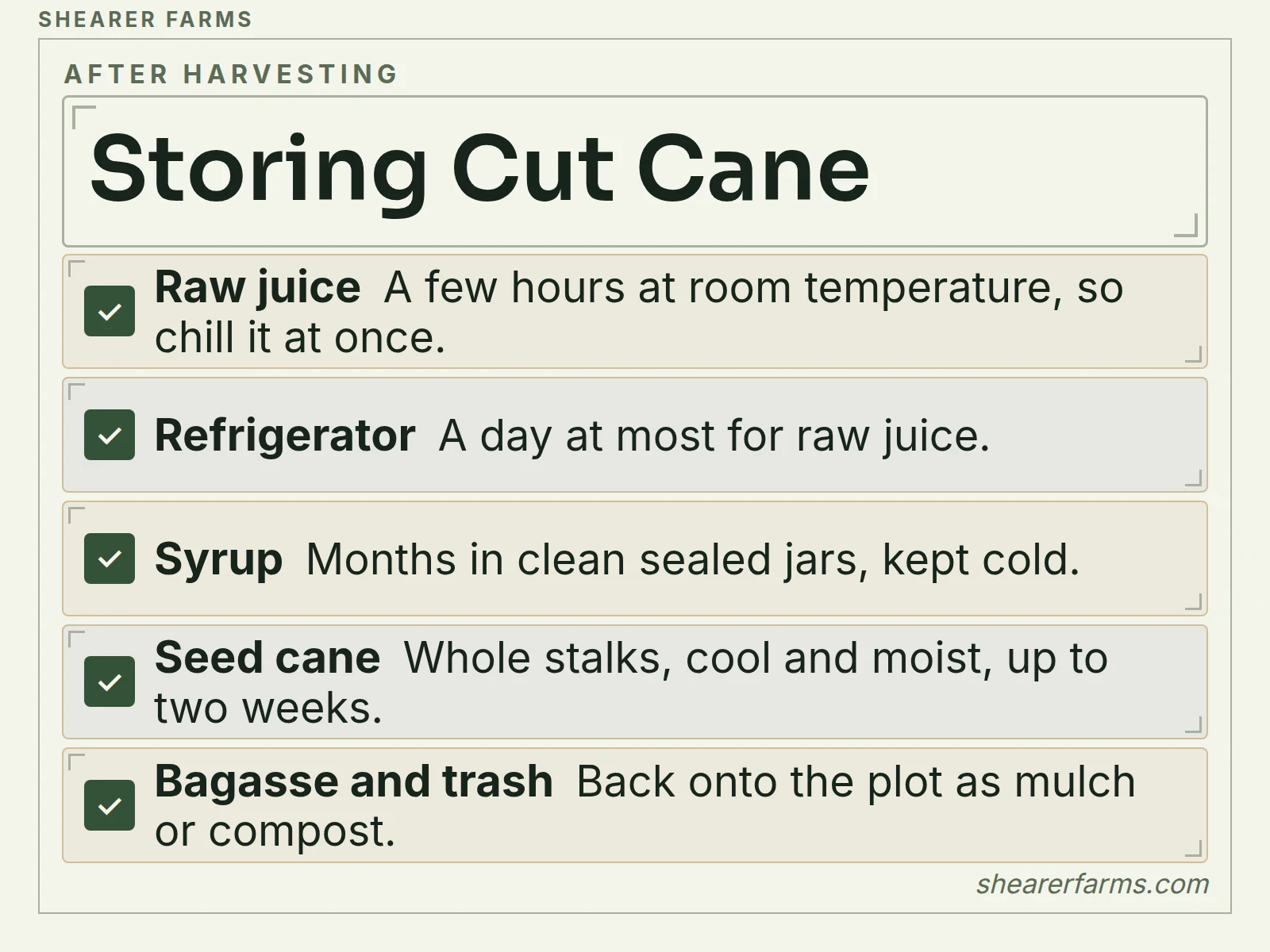
The longer-keeping forms of cane are syrup and sugar, both made by removing the water. Boiled in an open pan, juice becomes a syrup, and the old Louisiana syrup canes were grown for just this. Syrup keeps for months in clean sealed jars in the refrigerator.
For seed cane, store whole uncut stalks standing upright in shade, in cool moist conditions, for up to two weeks, and use hot paraffin on the cut ends if you need longer. Cut them into setts only on the day you plant, because cut ends dry out and rot quickly.
Bagasse, the pressed stalk, is best returned to the plot as mulch or compost, along with the ash from any boiler fire, and the leaf trash and tops go back on the ground as well.
Safety
Cane is a food with a long record, and a glass of fresh juice is a different thing from a concentrate. The cautions below come from what is documented about the plant and about working with it.
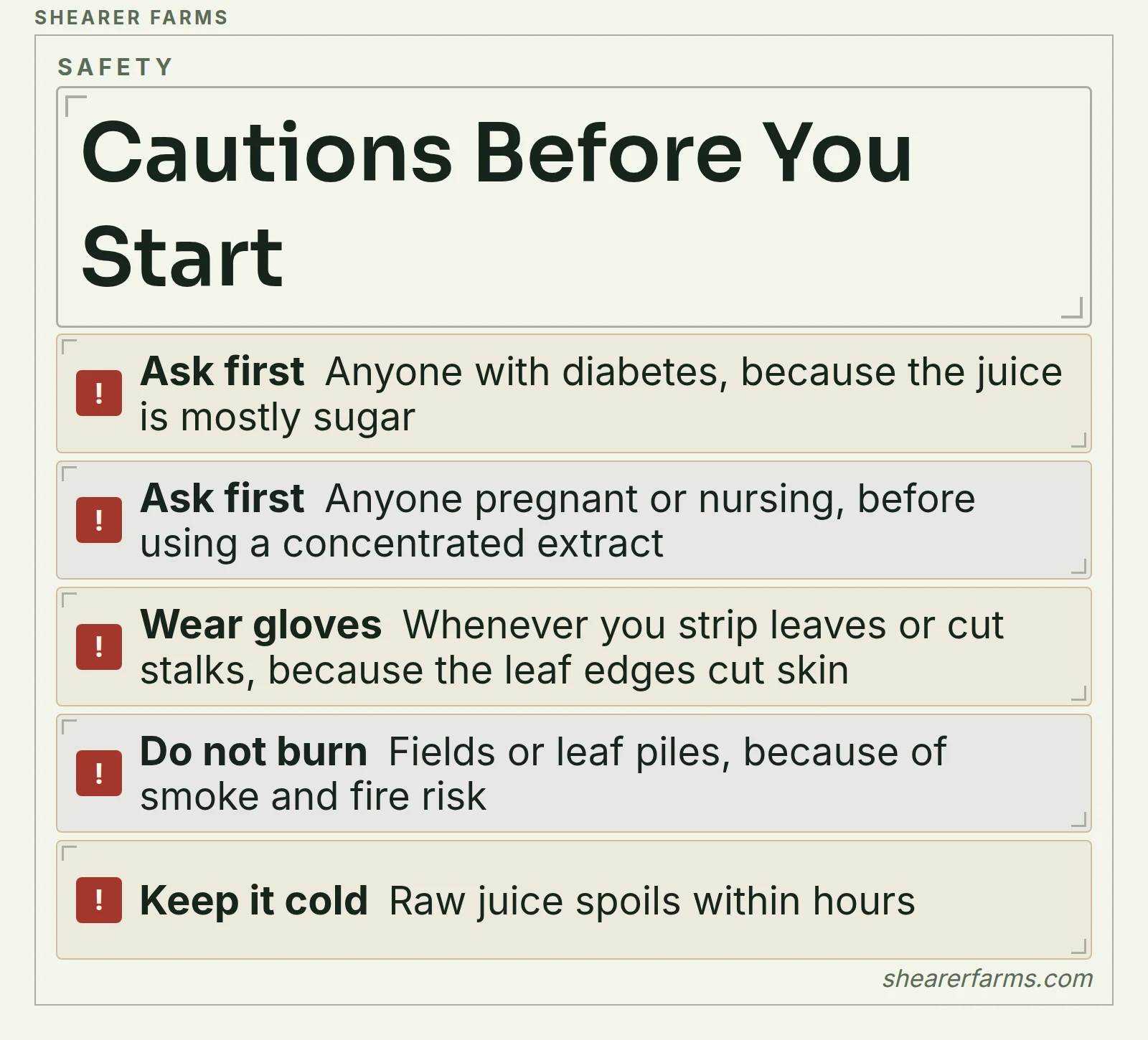
Three facts sit behind these cautions. Sugar cane juice is mostly sugar, so it raises blood sugar like any sweet drink. Raw juice spoils within hours and can cause stomach upset when contaminated. And the leaf edges and the stalk knives cut skin, so most injuries in a cane plot are cuts.
What to do
These steps keep the work safe for you and for the people who drink the juice.
- Wear gloves, sleeves and eye protection when you strip leaves and cut stalks, because the leaf edges are razor sharp.
- Use a sharp cane knife on a stable surface, and keep other people clear of the swing of the blade.
- Wash the stalks and the press before you juice, and chill the juice at once.
- Drink fresh juice the same day and keep it in the refrigerator until then.
- Tell your prescriber about regular cane juice or syrup if you take medicine for diabetes.
Pregnancy and nursing do not change the plan for ordinary food amounts, but a concentrated extract is a separate matter, and we leave that to a clinician.
What not to do
These are the things we leave out of the plan.
- Do not burn the field or the leaf piles to clear them, because the smoke and the fire risk reach your neighbors, and the leaves are better as mulch.
- Raw juice that sat at room temperature for the day goes in the bin and is not for drinking.
- Do not give raw juice or syrup to a person with diabetes as a casual drink.
- Bare arms and a bare face have no place along a cane row, because the leaf edges cut.
- Do not cut cane towards your own leg or hand.
This guide gives no medical advice, and a person with a health condition should ask a clinician about eating cane products.
Troubleshooting
Most trouble in a cane plot traces back to water, light or the weather. Use the checklist first, and then match what you see to the usual cause below.
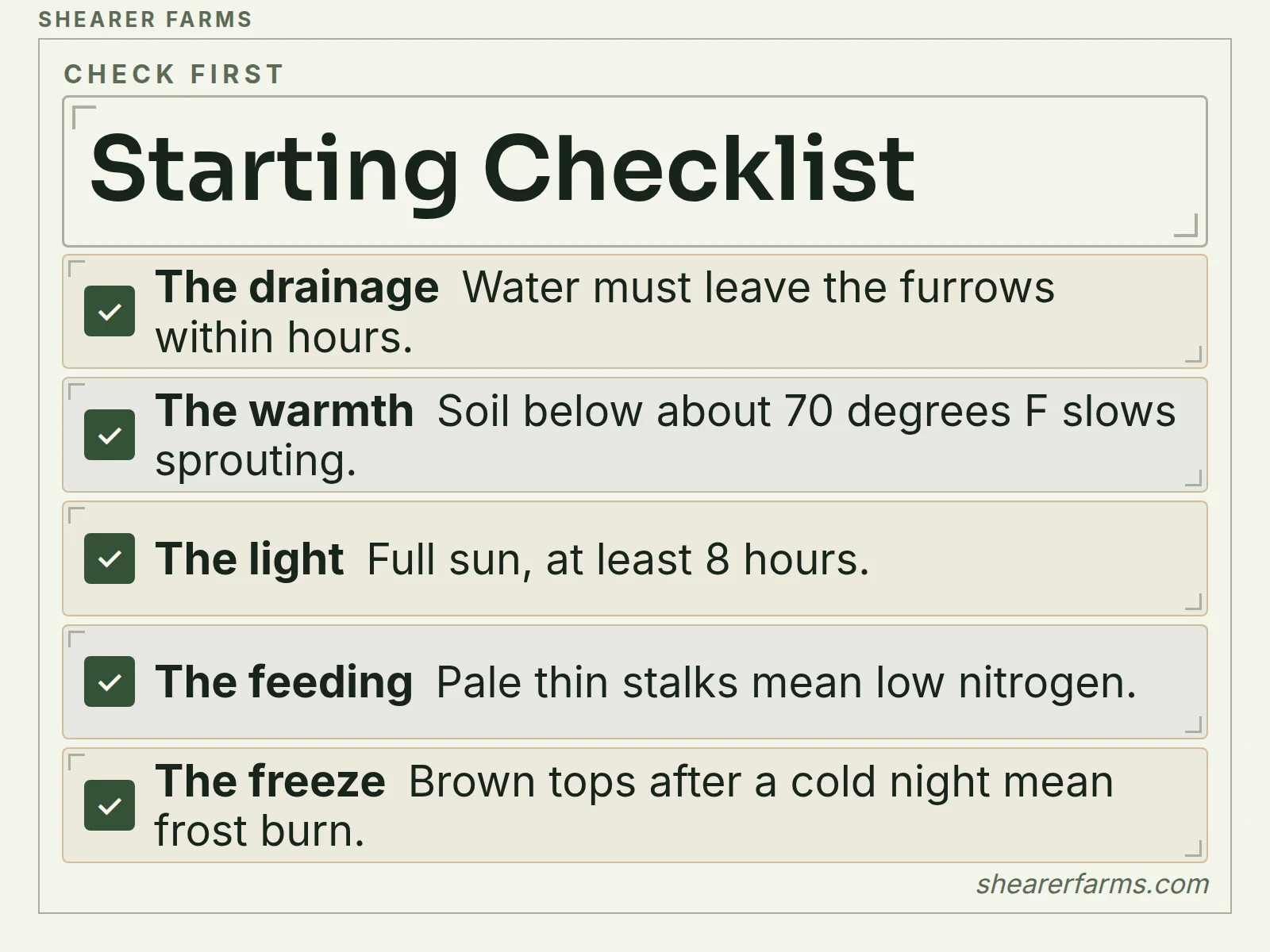
If the checklist does not explain it, write down what you see and the date, because the weather of the past few weeks usually points to the cause.
| What you see | The usual cause | What to do |
|---|---|---|
| Setts do not sprout | Cold or waterlogged soil, or dry rotted seed cane | Plant into warm, well-drained soil and use fresh seed cane |
| Thin, pale stalks | Low nitrogen or too little light | Feed to a soil test and clear shade |
| Yellow leaves in wet soil | Roots lacking air | Improve drainage and raise the rows |
| Brown, dead tops after a cold night | Freeze burn | Harvest soon, and mulch the base |
| Stalks lying over | Lodging in wind and soft soil | Hill soil around the base and harvest early |
| A hole in a stalk with frass | A stalk borer | Cut it out, discard it and keep the field clean |
Most of these come back to water, drainage and cold, so the fix is usually a change in how the plot is set up and not a spray.
Our partner website, Pure Extracts
Sugar Cane (Saccharum officinarum) Extraction Guide: Juice, Polyphenols, Wax and Bagasse
Make sugar cane (Saccharum officinarum) extracts: cold press juice, freeze dried juice, ethyl acetate wash, watery ethanol soaks.
References
- LSU AgCenter, Resistance of Louisiana sugarcane to deterioration from freezing temperatures: 32 to 25 degrees F kills tips, 25 to 22 degrees F damages buds and stalk tissue, below 22 degrees F kills all top growth of commercial varieties.
- LSU AgCenter, wait and see approach to sugarcane freeze damage: split stalks, waiting about a week to judge a freeze, newer varieties more cold tolerant.
- Growables, Sugarcane (Saccharum officinarum): height, node spacing, soil pH, temperature, seed pieces, furrow and cover depth, row spacing, storage of cuttings, harvest timing, ratoon timing, flowering, uses.
- BMC Plant Biology (2021), anthocyanin biosynthesis in sugarcane rind color, comparing green, red and purple (Badila) rinds: cyanidin and peonidin derivatives as the main rind pigments of Saccharum officinarum.
- Agriculture and Natural Resources (ThaiJO), study of phenolics and anthocyanins in a dark purple-to-black sugarcane sold in Thailand.
- University of Hawaii CTAHR, Korean natural farming, fermented plant juice (SA-7): equal weight of brown sugar and cut plant material, about seven days.
- University of Florida IFAS Extension bulletin on sugarcane varieties: syrup canes Louisiana Ribbon, Louisiana Purple and Green German, chewing canes White Transparent, Georgia Red, Home Green and Yellow Gal, and the difficulty of finding the old Louisiana canes.
- Indian Council of Agricultural Research, evaluation of Saccharum officinarum clones for chewing: low fiber, high juice quality and soft stalks; loss of rind color and stripes in breeding; Pele's Smoke as an ornamental clone.
- Texas AgriLife Extension, Rio Grande Valley historical yields: sugarcane about 31 to 42 tons per acre, 2012 to 2018.
- USDA, sugarcane genotype by environment interaction in clonal trials in the Texas Rio Grande Valley: plant cane followed through ratoon crops.
- Canarius, Saccharum officinarum 'Badila': thick, dark-stalked noble cane and ancestor of modern hybrids (a nursery listing).
- The shelf life of standardized sugarcane juice stored under refrigeration, Food Science and Technology (2020): raw juice pH 5.55, fresh juice lasts a few hours, pasteurized juice at pH 4.35 held 94 days at 4 degrees C.
- Systematic review of sugarcane (poly)phenols, Comprehensive Reviews in Food Science and Food Safety (2024): apigenin, luteolin and tricin derivatives.
Common questions
What is sugar cane?
Sugar cane, Saccharum officinarum , is a tall perennial grass that stores sugar in its stems. A mature stalk stands 4 to 12 feet tall, is 0.75 to 2 inches thick, and is divided into nodes 4 to 10 inches apart, each node carrying a bud that can grow a new plant. That bud is the whole secret of growing it, because cane is grown from pieces of stalk and not from seed, and a single stalk can become dozens of plants. This guide covers the noble cane, the species that was grown for thousands of years before modern hybrids replaced it, and it also says where a hybrid does better.
What climate does sugar cane tolerate?
Cane grows in the range of 70 to 95 degrees F (21 to 35 degrees C), and it grows fastest when days are hot and nights stay warm. Shoots from a planted piece appear in 1 to 3 weeks, depending on the soil temperature, and a cold soil slows them and can rot a piece before it sprouts. Plant only after the soil has warmed. Freeze is the main risk where winters get cold. Louisiana's sugar program has described what temperature does to commercial cane in bands, and those bands are the best guide we found for a grower with a cold winter.
What soil does sugar cane need?
Cane wants full sun, and a planting that gets less than 8 hours of direct light grows thin stalks with little sugar. Choose a site open to the sun and away from the shade of buildings and trees, and keep it away from walkways, because the leaf edges cut anyone who brushes past. The soil should be well drained, deep and loose, with a pH of about 5.5 to 6.5. A loam or clay loam with plenty of organic matter holds moisture without staying wet, and sandy soil needs more water and more feeding. Check the pH with a soil test before you plant, and add lime if it is well below 5.5.
How do I grow sugar cane?
A grower asks three questions before buying cane: which variety gives the most stalk, which has the most of the compound you want from it, and which survives the coldest winter. Each answer is below with the reason, and each says how far the evidence goes. For noble cane, the honest answer is that the published trials are thin. We grow two canes ourselves, Thai purple and heirloom sugar cane, and both are useful to us. Thai purple has dark purple stalks.
How do I propagate sugar cane?
What you grow cane for decides almost everything about how you grow it. This guide treats two goals as the main ones: the sap, which is the sugary juice in the stalk, and the clones, which are the pieces of stalk that become new plants. Everything that raises the yield of one also helps the other, and the differences are in the timing. We grow Thai purple and heirloom cane for their sugar. We use that sugar in Korean natural farming ferments and in molasses-type additions to our nutrients, which feed the microbes in the soil.
How much water does sugar cane need?
After the shoots are up, the work is to keep the plant growing fast through the warm months. Give cane a deep watering rather than frequent sprinkles, so the roots reach down, and water more in the hot weeks of summer when growth is at its peak. Stop heavy watering as harvest nears and the weather cools, because the plant is now filling the stalk with sugar and a wet root zone dilutes it. Feeding follows the soil test. Cane is a heavy feeder, and the nutrient that most often limits growth is nitrogen, so a plot without enough of it produces thin pale stalks.
What are ratoon crops?
A ratoon is a crop that regrows from the stubble after the cane has been cut. Because the roots and the buds are still in the ground, new shoots come up within days of harvest, and the planting yields again without any seed cane or planting labor. The first crop after planting is called plant cane, and each regrowth after it is a first ratoon, a second ratoon and so on. Timing is shorter for a ratoon. Plant cane takes about 12 to 14 months from planting to harvest, and a ratoon takes about 11 to 12 months from regrowth.
What pests and diseases affect sugar cane?
Cane is a tough plant, and most problems in a small plot come from the conditions and not from an insect or a disease. Check the basics first, which are water, drainage, light, feeding and freeze damage, and look at the pests only when those are right. The common problems are easy to recognize. Pale thin stalks mean low nitrogen or too little light. Yellow leaves in wet soil mean the roots lack air.
When should I harvest sugar cane?
Cane is ready 12 to 14 months after planting, or 11 to 12 months from regrowth for a ratoon. Sugar yields generally rise as the weather cools, so the best harvest is on a cool, dry day in autumn or winter, before the first hard freeze. Test by cutting one stalk and measuring the juice with a refractometer, which reads the sugar as Brix, and harvest the plot when the reading stops rising. Cut each stalk as close to the ground as you can with a machete or a cane knife, because the root end is the richest in sugar and the cut low also leaves good buds for the ratoon.
Is sugar cane safe?
Cane is a food with a long record, and a glass of fresh juice is a different thing from a concentrate. The cautions below come from what is documented about the plant and about working with it. Three facts sit behind these cautions. Sugar cane juice is mostly sugar, so it raises blood sugar like any sweet drink. Raw juice spoils within hours and can cause stomach upset when contaminated.
Browse by topic
More guides to explore
 GrowingDamiana Cultivation Guide
 GrowingChamomile Cultivation Guide
 GrowingCitronella Grass Cultivation Guide
 GrowingCats Claw Cultivation Guide
 GrowingCordyceps Mushroom Cultivation Guide
 GrowingCalendula Cultivation Guide
 GrowingAgarita Cultivation Guide
 GrowingAloe Vera Cultivation Guide
 GrowingAshwagandha Cultivation Guide
 GrowingBacopa Monnieri Cultivation Guide
 GrowingBlue Java Banana Cultivation Guide